| Description |
PREFACE
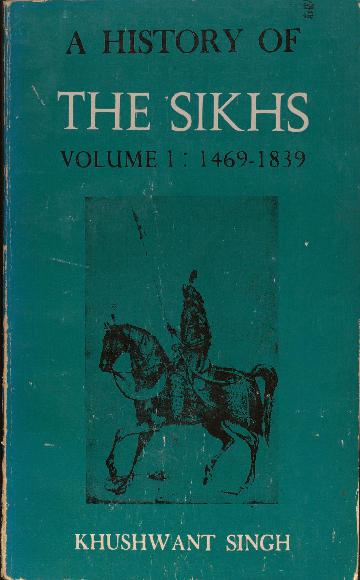
EVER since its publication in 1849, Captain
Joseph Davey Cunningham's History of the Sikhs has been considered the standard work on the religion and history of the Sikhs. Since then extensive research has been done on different aspects of Sikh history: large portions of their scriptures have been translated; records bearing on the building of the Sikh church and community have been unearthed; the founding of an independent Punjabi state under Sikh auspices and its collapse after the death of Ranjit Singh have been explained. However, no attempt has been made to revise Cunningham's work in the light of these later researches; nor, what is more surprising, has anyone undertaken to continue Cunningham's narrative beyond the end of the First Sikh War and the partial annexation of the Punjab by the British in 1846.
This work is the first attempt to tell the story of the Sikhs from their inception to the present day. It is based on the study of original documents in Gurmukhi, Persian, and English available in the archives and libraries of India, Pakistan, the United Kingdom, Canada, and the United States. It also gives an account of the Sikh communities scattered in different parts of the world—Great Britain, the United States, Canada, China, Malaya States, Burma, and South and East Africa—and of the way they are facing the challenge of modern times in alien surroundings.
The story of the Sikhs is the story of the rise, fulfilment, and collapse of Punjabi nationalism. It begins in the latter part of the 15th century with Guru Nanak initiating a religious movement emphasising what was common be tween Hinduism and Islam and preaching the unity of these two faiths practised in the Punjab. By the beginning of the 17th century the movement crystallised in the for mation of a third religious community consisting of the disciples or sikhās of Nanak and the succeeding teachers or gurus. Its mysticism found expression in the anthology of their sacred writings, the Ādi Granth, comprised of the writings of the Sikh gurus as well as of Hindu and Muslim saints. The next hundred years saw the growth of a political movement alongside the religious, culminating in the call to arms by the last guru, Gobind Singh. Within a few years after the death of Gobind Singh, the peasants made the first attempt to liberate the Punjab from Mughal rule. Under the leadership of Banda they defied the authority of Mughal governors and kept the imperial armies at bay for a full seven years. Although Banda and his followers were ruthlessly slaughtered, the spark of rebellion that they had lighted smouldered beneath the ashes and burst into flame again and again in different parts of the province. The period which followed witnessed a renewal of invasions of Northern India by Afghan hordes led by Ahmed Shah Abdali, which gave a further impetus to the growth of Punjabi nationalism. Peasants grouped themselves in bands (misls), harassed and ultimately expelled the invaders.
The movement achieved its consummation with the liberation of Lahore and the setting up of the first independent Kingdom of the Punjab under Ranjit Singh in A.D. 1799—by a curious coincidence exactly one hundred years after Guru Gobind Singh's call to arms (1699), just a little under two hundred years after the compilation of the Adi Granth (1604), and three hundred years after the proclamation of his mission by Guru Nanak (1499). Under Ranjit Singh, the Punjabis were able not only to turn the tide of invasion back into the homelands of the traditional conquerors of Northern India, the Pathans and the Afghans, but also to make their power felt beyond the frontiers-northwards across the Himalayas; across the Khyber into Afghanistan; in Balochistan, Sindh, and in Northern India as far as Oudh. The Sikhs became the spearhead of
the nationalist movement which had gathered the parent communities within its fold. The achievements were those of all Punjabis alike, Hindus, Muslims, and Sikhs. It was in the fitness of things that in the crowning successes of Pun jabi arms, the men who represented the state were drawn from all communities. In the victory parade in Kabul in 1839 (a few months after Ranjit Singh's death) the man who bore the Sikh colours was Colonel Bassawan, a Pun jabi Mussalman. And the man who carried the Sikh flag across the Himalayas a year later was General Zorawar Singh, a Dogra Hindu.
This is the theme and substance of Volume I and the first part of the projected second volume. The rest of the next volume will continue the narrative and tell how the nationalist movement, having run its course, began to peter out and finally collapsed in a clash of arms with the British in 1848-1849. It will also recount how the Sikhs, who, within a couple of centuries of their birth, had evolved a faith, outlook, and way of life which gave them a semblance of nationhood, have had to fight against the forces of dissolution to preserve their identity. It will deal with the political and social movements that took place during Brit ish rule, the fate of the Sikhs in the partition of their homeland in 1947, their position in independent India, and the demand for an autonomous Punjabi state within the Indian union.
Acknowledgments
I would like to express my gratitude to Dr. Percival Spear of Selwyn College, Cambridge, Dr. Sir Gokul Chand Narang, Sardar Sardul Singh Caveeshar, and Sardar Bahadur Ujjal Singh for reading the manuscript and making valuable suggestions; to Krishna Shungloo for his assistance in translating the hymns published in the appendix; to V. S. Suri, Curator of the Punjab Government Archives, Patiala, for placing unpublished material on Ranjit Singh
at my disposal; and above all to Miss Yvonne Le Rougetel, who collaborated with me in the research.
I would also like to place on record my deep sense of gratitude to the Rockefeller Foundation, which made it possible for me to travel extensively and devote myself exclusively to this work for three years, and to the Muslim University, Aligarh, which sponsored the research.
For the revised paperback edition I acknowledge assistance given by Satindra Singh of “The Economic Times” and Rajinder Singh Bhatia, Editor of Qaumi Ekta.
KHUSHWANT SINGH
Editor Illustrated Weekly of India, Bombay |