| First Sentence |
Foreword
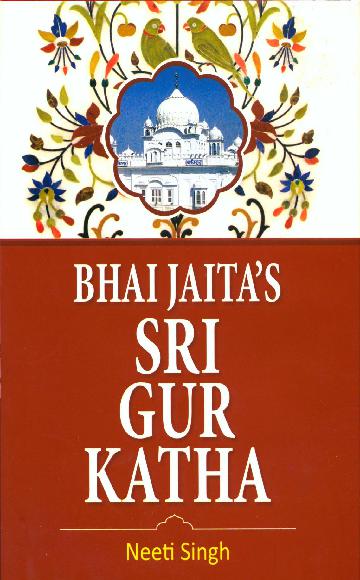
Bhai Jaita's Sri Gur Katha is his tribute to the Sikhi in general
and the last Guru in particular. The manuscript seemingly
remained unnoticed with some of the Mazhabi Sikh families.
The two manuscripts or copies that surfaced in the mid twentieth
century have an interesting tale as narrated by Naranjan Singh
Arifi, a passionate researcher about Mazhabi Sikhs and the
author of Ranghretian da Itihas. It was in 1973 that Arifi was told
by Dhanna Singh Gulshan, an accomplished kavishar (bard) and
former Akali Dal MP and Union Minister, that he had procured
a Sri Gur Katha manuscript from Santa Singh, father of the
celebrated Punjabi poet Daya Singh Arif (1894-1946) who in
turn had got it from Baba Bir Singh of village Muthhianwala in
Firozepur district. Gulshan had a strong inclination to work on
the manuscript but his demanding political life hardly left time
for the job. Meanwhile, Giani Garja Singh (1907-1977), a keen
collector and scholar of Sikh manuscripts, borrowed the Sri Gur
Katha manuscript from Gulshan and misplaced it. Nonetheless,
Giani had prepared a copy before the manuscript was untraceable.
The second manuscript was discovered by Arifi from the same
family of Daya Singh Arif. This manuscript was gifted to Kultar
Singh, son of Daya Singh Arif, an accomplished musician, by the
Assam Sikhs on one of his kirtani jatha's trip to that area in
1950s. The latter manuscript, 18.1 x 11.45 cms, presently in the
custody of Naranjan Singh Arifi carries 36 folios, tightly written
in an unbroken line.
Dating of events and individuals of Sikh history has been
a major problem with majority of the hagiographic or other
sources of Sikh religion. Sri Gur Katha is no exception. There10
Foreword
is no date of its composition as none of the events and episodes
it records are dated. But the excellent long poem carries poet's
authorial name; Jaiyata or Jaiyate figures 13 times whereas as
Jeevan Singh is registered at 5 places. The Katha opens with
an invocation, unfolds with 'Ardas', sings of praises of 10
Gurus in 'Ustati', portrays the personality of Guru Gobind
Singh in 'Chitra', moves to the martyrdom of Guru Tegh
Bahadur, Guru's convocation of a divan at Damdama (Anandpur)
and conferring of new identity of Singhs onto the Five Beloved,
narrates a story of Jaita's rescuing a Brahmin's wife forcefully
retained by a Turk, moves on to the machinations of Bhim
Chand resulting in Guru's moving to Paonta and construction
of forts, provides a fair picture of the Battle of Bhangani, brings
the Guru back to Anandpur soon thereafter where a new panth
of Khalsa is finally launched, describes the qualities and form
of the new Sikh/Singh with an explicit mention of panj kakkar.
The Katha ends up with two sections of exceptional quality on
'Amrit bidh' and 'Rahit'. If we keep the sequence of episodes
in the Katha in mind while granting a fair sense of chronological
order to its composer, a different sets of alternative dates as
juxtaposed to the generally accepted but also doubted dates
relating to Guru Gobind Singh's life and times emerge.
A close reading of Sri Gur Katha hints at the event of the
'creation of Khalsa' in two phases rather than a single event as
so far understood. The first phase is a pre-Bhangani call by
Guru Gobind Singh to the Sikhs from far and wide for an
assembly at Anandpur with emphasis to come with war
material. The title of 'Singh' is conferred upon the five Sikhs
who came forward to give their lives in the dramatic
convocation. That was apparently done to infuse a new spirit
in the Sikhs to prepare them for the impending wars. But that
seems to have been just a beginning of the process with not
many assuming the title of Singh as is clear from the names of
Sango Sah and Jeet Mal, the close relatives of the Guru, whoForeword
11
were killed at Bhangani. Having tested the success of the
experiment in the battlefield of Bhangani and back in Anandpur,
the Guru thought of then launching the 'New Panth' of Khalsa
with an elaborate amrit ceremony of 'khande dee pahul'.
The three important dates of Sikh history for reconsideration
as suggested by Gurinder Singh Mann "Sources for the Study
of Guru Gobind Singh's Life and Times", (Journal of Punjab
Studies, 15, 1 & 2, 2008) are: birth of Gobind in 1666, creation
of the Khalsa in 1699, and replacement of the personal Guru
with Guru Granth in 1708. Since the last episode is exterior to
Sri Gur Katha, its composer having died in the Battle of
Chamkaur in 1704, its implicit potential to contribute
significantly to the other two vital episodes is very important.
Apparently there is no seventeenth century source on the birth
date of Guru Gobind Singh but as pointed out by Mann the four
eighteenth-century sources, Chaupa Singh (1700), Kesar Singh
Chhibbar (1769), Sarup Das Bhalla (1776), and Sarup Singh
Kaushish (1790) mention the year of his birth as 1661 while
it is Sukha Singh (1797) alone who records it as 1666 and quite
strangely such a late source has come to be accepted by the later
Sikh tradition as the correct date. Sri Gur Katha would be
helpful but only in conjunction with the dating of the Khalsa.
None of the eighteenth century sources places it in 1699;
majority of them put the creation of Khalsa between 1695 and
1698 while the minor voice of Koer Singh Kalal places it in
1689. It is only the late-nineteenth century 'invention' of 1699
by Giani Gian Singh which has enjoyed the wide acceptance
since then. But the latest discovery by Mann of 'new category
of artifacts' especially copper-plates (tamar patar) attributed to
Guru Gobind Singh has posed a new challenge to the scholars.
The copper-plate issued in 1679 bestowed on Jawala Das
Brahman of a Shiva temple in Kapal Mochan near Paonta
assumes a special significance as it talks about Khalsa while
Guru's name is inscribed as 'Gobind Singh'.12
Foreword
If we follow Bhai Jaita's sequence of events the first phase
of the creation of Khalsa comes in quick succession to the
martyrdom of Guru Tegh Bahadur. After he offered the severed
head of the Guru to the young Gobind, the Ranghrettas were
pronounced as sons of the Guru. The popular saying 'ranghrette
guru ke bette' gets confirmed by Jaita's self-statement: 'Jaiyate
taaranhaar gur, taar diye ranghret.de. Gur paras ne kar diye
ranghrete gur bet.de.' (O Jaita! The eternal boatman, the Guru,
has ferried across the rangrettas / The touchstone of His grace
has turned the rangrettas, into Guru-ka-bettas) The martyrdom
is presented by Jaita as the major reason for Guru Gobind to
analyse the critical situation and for charting a new strategy for
the Sikh community. The Guru is shown to be wondering why
the Sikhs of Delhi did not stand by their guru; why they did not
feel ashamed at their inaction; why even the Muslims could not
recognise the Sikhs as different from Hindus; why even the
young Sikhs turned into stones; why the Hindustanis did not
feel agitated; why their arms turned into pieces of straw; why
they could not rise to the occasion and could not know their
grand duty? Contemplating on these questions the Guru
resolved to empower the Sikhs with new identity of warriors
and intellectuals. Guru Gobind spent several days in reflection
on the pros and cons of such a move at Damdama in Anandpur
and then came out with unsheathed sword while singing songs
of the weapon. He then sent messages to the Sikhs in all
directions to come to Damdama with weapons and horses and
thus created Khalsa. If we now keep the Kapal Mochan copper-
plate of 1679 issued by the Guru with his name inscribed as
'Guru Gobind Singh' and also keep Bhai Jaita's sequence of
events in Sri Gur Katha it comes closer to Mann's suggestion
for reconsidering the date, we are in a position to place the first
phase between 1676 and 1678. While the 'Five Beloved' are
conferred with the title of 'Singhs', Gurus assuming himself the
same title and then using it on the 1679 copper-plate makesForeword
13
sense. In conjunction with Bhai Jaita's narrative it becomes
easy to give credence to Koer Singh's 1689 as the date of the
creation of Khalsa and that makes still a better sense keeping
in mind with what spirit and vigour several battles were
successfully fought by Sikhs, now mostly Singhs.
None of the earlier sources, not even the late-eighteenth
or early nineteenth century, talks of 'Panj Kakkars'. Ever since
the Singh Sabha's authoritative sanction to the Guru's injunctions
in this respect in the last quarter of the nineteenth century it has
occupied the attention and energy of the Sikh scholars to find
academic answers to the opaqueness about such a central issue
in the sources. In an exhaustive analysis of these sources and
also of their twentieth century interpretations, W.H. McLeod
while accepting the possibility of the five items having been
worn by the Khalsa Sikhs since the earliest days of the order
reaches a conclusion that there is no evidence that Guru Gobind
Singh decreed the Five Ks and promulgated at the inauguration
of the Khalsa. One wishes he had seen and studied Sri Gur
Katha as well to clear the fog with his own mind.
Once Guru Gobind Singh had fixed the five symbols for
a distinct identity of the Khalsa he also made changes in the
earlier practice of Sikh initiation with an elaborate ritual of
'amrit bidhi' as given by Bhai Jaita.
After making a clear statement on 5Ks and offering the
details of the initiation ritual Bhai Jaita elaborates Guru Gobind
Singh's manual of the Sikh, more specifically the Singh code
of conduct, the Rahit, in the closing section of Sri Gur Katha.
As a work of poetry, Sri Gur Katha stands out as one of
the finer pieces of Punjabi literature. Composed in the last
decade of the seventeenth century, its language, diction and
vocabulary is the same as used in the Dasam Granth, attributed
to Guru Gobind Singh, and other poets attached to the Guru's
court. Bhai Jaita emerges as an accomplished poet using
popular but also difficult chhants prevalent at the time.14
Foreword
Rendering his poetry in sabad, sawaiya, soratha, kabitt,
sirkhandi, chaupai, kundaliya, rola and adil he has also used
the most lyrical dohira. Looking at Bhai Jaita's command over
language and maturity of his poetry and the manner in which
it surfaced very late in the public domain it is not difficult to
assume that he could have composed other works as well. But
given the violent times in which a large literary heritage of
Sikhs was lost it is possible that his other work/s could have
met the similar fate. Notwithstanding such speculations, Sri
Gur Katha turns out to be a major milestone in the Sikh
literature as it becomes the earliest source about the 'creation
of Khalsa', new initiation 'khande dee pahul' and Guru Gobind
Singh's rahit. Most importantly, it becomes the first testimony,
an eyewitness account, to talk unambiguously about the 5Ks
(Panj Kakkar), in a way textually validating the late nineteenth
century Singh Sabha assertion based on the Khalsa Sikh
memories and practices. Sri Gur Katha proves to be the real
landmark in Sikh history and literature as an implicit assistant
in settling couple of major dates about Guru Gobind Singh,
namely his birth and creation of the Khalsa.
Neeti Singh has competently translated Sri Gur Katha.
Familiar with the medieval poetic language of Sants, after
having done doctoral dissertation on compositions of Kabir and
Nanak, and having command over both the languages, Dr Singh
has rendered a great service to this very important source in the
history of Sikhs and Punjabi literature. Sardar Gursagar Singh
of 'Singh Brothers' deserves congratulations for publishing
such an important Sikh source for the wider audience of the
English-knowing world.
Raj Kumar Hans
Department of History,
The Maharaja Sayajirao University of Baroda,
Vadodara. |