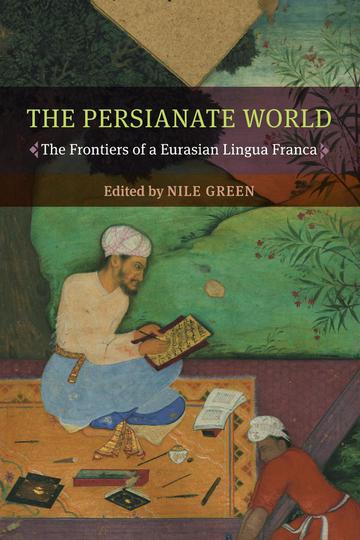
The Persianate World: The Frontiers of a Eurasian Lingua Franca
| Creator | Nile Green |
| Description | Introduction The Frontiers of the Persianate World (ca. 800–1900) Nile Green DEFINING THE “PERSIANATE” By the fifteenth century, having gained written form as a fashionable patois of the court poets of tenth-century Bukhara, Persian had become a language of governance or learning in a region that stretched from China to the Balkans, and from Siberia to southern India.1 As a lingua franca promoted by multi-ethnic and multi-religious states, and aided further by education and diplomacy, Persian reached the zenith of its geographical and social reach between the sixteenth and eighteenth centuries. Then, from the early nineteenth century on, it was undermined by the rise of new imperial and vernacular languages. By around 1900, the language, which had once served to connect much of Eurasia, had retreated to Iran and neighboring pockets of Afghanistan and Central Asia, where it was refashioned into the national languages of Farsi, Dari, and Tajiki. The period between 1400 and 1900, then, marks an era defined by the maximal expansion then rapid contraction of one of history’s most important languages of global exchange. |
| First Sentence | THE PERSIANATE WORLD The Frontiers of a Eurasian Lingua Franca Edited by NILE GREEN |
| Published | 2019 |
| Language | English |
| Pages | 366 |
| Copies | 1 |
| Tags | Persian Sikh |
| Collection | Community Texts |
| Read | 3 times |