The Sikhs of The Punjab
| Creator | J. S. Grewal |
| Description | Writing his History of the Sikhs in the 1960s Khushwant Singh looked upon J. D. Cunningham as his predecessor whose work, written over a century earlier, had become a classic. Khushwant Singh himself has written with 'power and passion' under 'masterly restraint'. That the present volume takes into account the research on Sikh history during the past two decades may be regarded as its major claim upon the reader's attention. It touches upon religious, social, political, economic, cultural and demographic developments over the entire span of Sikh history. Within the broad context of Indian history, Sikh history falls into four well-marked periods: from its beginning with the mission of Guru Nanak to the death of Guru Gobind Singh in 1708; from the rise of Banda Bahadur to the annexation of the Punjab by the British in 1849; the near century of colonial rule up to 1947; and the four decades of Independence. During the past century historians of the Sikhs have concentrated on the first two periods. Interest in the colonial period goes back only to the 1960s. The movement for a Punjabi-speaking state and the crisis culminating in the Operation Bluestar in June 1984 have induced many a writer to take interest in the history of the Sikhs in independent India. This broad pattern of historiography is reflected in the treatment of Sikh history in the present volume: generalizations yield more and more place to factual though analytical narrative as we pass from one period to another in an attempt to identify change. For an invitation to pursue a subject which had been my major occupation for two decades, I am thankful to the Syndics of the Cambridge University Press; I am equally thankful to the editors of The New Cambridge History of India for leaving me all the freedom I needed to write this volume. I am indebted to many scholars and institutions for help, but I would like to mention specifically Professor Indu Banga and Professor W. H. McLeod among the scholars, and the Nehru Memorial Museum and Library, New Delhi, the Indian Council of Historical Research, New Delhi, Guru Nanak Dev University, Amritsar, and the Indian Institute |
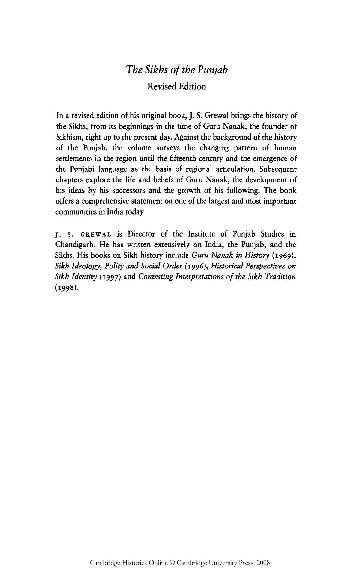
| First Sentence | The Sikhs of the Punjab Revised Edition In a revised edition of his original book, J. S. Grewal brings the history of the Sikhs, from its beginnings in the time of Guru Nanak, the founder of Sikhism, right up to the present day. Against the background of the history of the Punjab, the volume veys the changing pattern of human settlements in the region until the fifteenth century and the emergence of the Punjabi language as the basis of regional articulation. Subsequent chapters explore the life and beliefs of Guru Nanak, the development of his ideas by his successors and the growth of his following. The book offers a comprehensive statement on one of the largest and most important communities in India today J. S. GREWAL is Director of the Institute of Punjab Studies in Chandigarh. He has written extensively on India, the Punjab, and the Sikhs. His books on Sikh history include Guru Nanak in History (1969), Sikh Ideology, Polity and Social Order (1996), Historical Perspectives on Sikh Identity (1997) and Contesting Interpretations of the Sikh Tradition (1998). Cambridge Histories Online Ⓒ Cambridge University Press, 2008 |
| Published | 1998 |
| Language | English |
| Width x Height | 1200 x 1800 |
| Pages | 293 |
| Copies | 1 |
| Tags | Sikh History |
| Collection | Community Texts |
| Read | 6 times |